
“A patient sits in front of you, phone in hand. ‘I think I have POTS… I saw it on TikTok.’”
Social media is no longer peripheral to healthcare, it is embedded within it. From how patients interpret symptoms to how clinicians learn, connect, and advocate, digital platforms are actively shaping the clinical landscape we practice in every day. In this Grand Rounds summary we look at the growing intersection between emergency medicine and the algorithm-driven world of social media, highlighting both its educational potential and its risks. As emergency providers, we increasingly encounter patients whose understanding of illness is influenced by what they have seen online, and we ourselves are participants in this evolving ecosystem. Understanding how social media functions, and how it impacts both providers and patients, is now a necessary clinical skill rather than a peripheral interest.
Disclaimer: All social media content shown during today’s presentation is from public accounts, is being used for educational purposes and all rights belong to the original creators
- Establish the role that social media plays in medical education and provider wellbeing
- Describe the relationship between social media, dissemination of health-related information and advocacy
- Examine the ways in which social media influences patients as they navigate acute and chronic illness
- Analyze the relationship between social media, symptom identification and diagnostic clarification
- Explore the challenges related to social media use and their real-life outcomes
- Identify strategies for healthcare workers to address misinformation on social media
Why do we Care?
- There are approximately 5.66 billion social media users worldwide, representing roughly 70% of the global population [1]
- Among individuals older than 16 years, 88% consume an average of 7 hours of social media per week, distributed relatively evenly across platforms such as TikTok, Instagram, YouTube, and Facebook
- Among Gen Z users, this rises to upwards of 7 hours per day [2]
- Among individuals older than 16 years, 88% consume an average of 7 hours of social media per week, distributed relatively evenly across platforms such as TikTok, Instagram, YouTube, and Facebook
- More than 25% of global social media users report checking their symptoms online, and 80% state that online resources influence their treatment decisions
- Local pre–Grand Rounds survey data show that 91% of respondents use social media, with average daily use between 1 and 3 hours, and 80% report encountering patients who reference social media during clinical assessments
- Taken together, social media is playing an increasingly central role in how people navigate both everyday life and healthcare
Social Media Overview
According to Merriam-Webster, social media is defined as electronic communication through which users create online communities to share information, ideas, personal messages, and other content [3].
- Short-form content: Videos posted on platforms such as Instagram, Facebook, TikTok, and YouTube that are typically less than 3 minutes in length, often incorporating trending audio and covering a wide range of topics.
- These fast-paced, high-arousal videos, combined with continuous scroll-based navigation and personalized algorithms, thrive in today’s “attention economy.” Information is no longer disseminated solely through traditional modalities such as textbooks, articles, or didactic teaching, but increasingly through content that is accessible, concise, and attention-grabbing
- Two main ways of accessing content on social media:
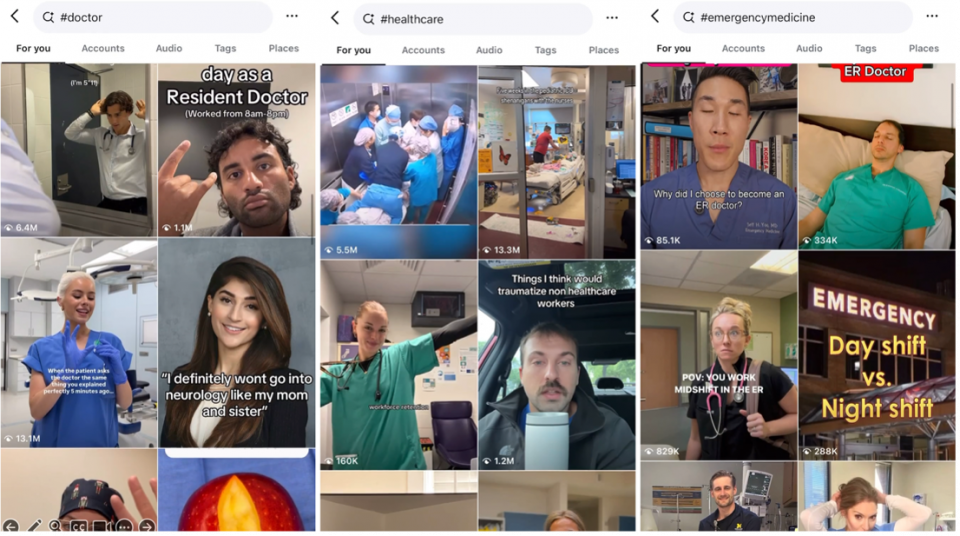
- Searching via keywords or hashtags (e.g., on Instagram)
- #doctor yields approximately 20.6 million posts
- #healthcare yields approximately 16 million posts
- #emergencymedicine yields approximately 578,000 posts
- The Explore page or “For You Page” (FYP), which is a continuously evolving feed curated by platform-specific algorithms, delivering content tailored to a user’s interests and prior interactions
- Searching via keywords or hashtags (e.g., on Instagram)
Social Media through the lens of Healthcare Providers
1. Medical education
- A growing body of evidence suggests that short-form content can enhance educational outcomes, improve knowledge retention, and promote collaboration and self-directed learning
- Short-form content is now being created across all stages of medical education, from undergraduate training to late-career continuing professional development
- In a study by Alsaid et al., medical students who viewed 90-second educational Instagram videos demonstrated improved short-term academic performance and higher engagement compared to those who did not consume this content [4]
- Spaced repetition occurs organically, as users are continuously exposed to content aligned with their recent searches and interactions, creating a cycle of repeated educational reinforcement
2. Networking and community development
- Social media removes traditional barriers of geography, language, and time zones, allowing healthcare professionals to connect with leaders in their field and build meaningful relationships early in their careers
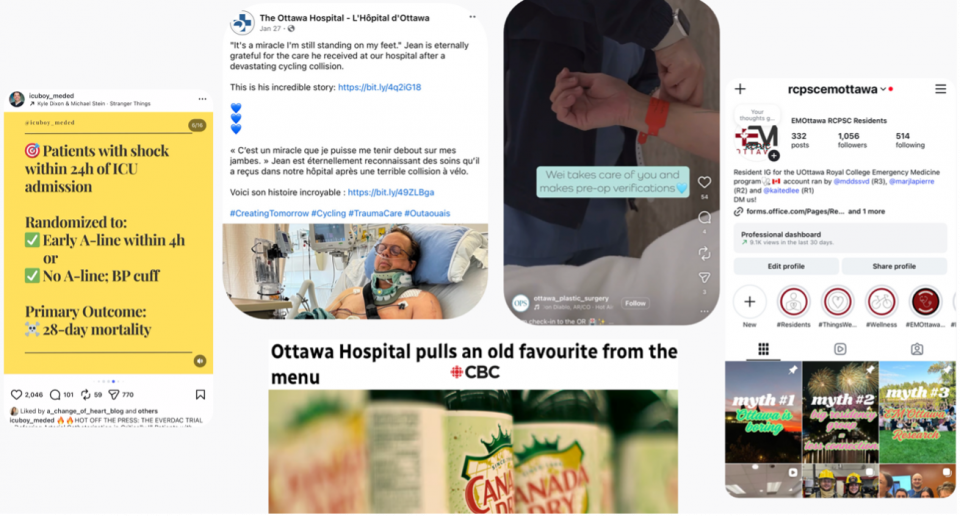
- It is increasingly used to amplify research, enabling rapid dissemination of concise, up-to-date findings in an accessible format
- A healthcare center’s social media presence has been shown to influence patient perceptions of innovation, strengthen the patient–provider relationship, and enhance trust and transparency [5]
- Residency program accounts offer prospective applicants an authentic, real-time view into training environments, accessible from anywhere
- Our program’s Instagram page has generated over 53,000 views in the past 3 months, with content consistently reaching audiences across more than three continents
Advocacy and dissemination of reliable public health information
- Misinformation: Publicly available information that is misleading or inconsistent with the best available scientific evidence, often contradicting guidance from evidence-based institutions. It is typically shared by individuals who believe it to be accurate, without malicious intent [6]
- Disinformation: False, inaccurate, or misleading information that is deliberately created and disseminated to cause harm or for personal or financial gain [7]
- Strategies to reduce the spread and consumption of inaccurate medical information:
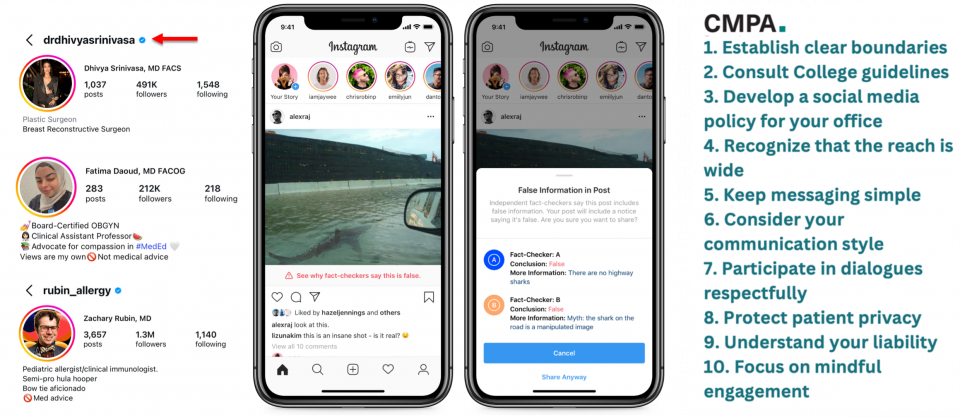
- Verify a creator’s credentials and professional affiliations, as outlined in their profile or bio
- Look for verified accounts (e.g., blue checkmarks), while recognizing that verification alone does not guarantee accuracy
- Utilize platform-integrated misinformation warnings and supports when available [8]
- For healthcare professionals creating content, adhere to established guidelines from governing bodies such as the CMPA [9]
- Healthcare workers using their social media presence for advocacy – Not only is social media being used to debunk fake news, but it is also become an expansive platform to address healthcare inequities
- Instagram accounts such as Brown skin matters have been created to address the significant lack of educational material about dermatological conditions on skin of colour
- #medbikini, a healthcare provider created movement in response to a sexist article (now retracted) published by the Journal of Vascular Surgery, suggesting that healthcare providers who post photos of themselves in bikinis are unprofessional
- Over 27k posts were made in response to this article, showing that HCPs can both wear whatever they want and still be competent professionals
- Healthcare providers posting short videos addressing stereotyping and systemic discrimination against women and underrepresented minorities
Social media as it is used by patients/consumers
1. Seek out Health Information
- Social media transcends geographic and financial barriers, allowing users to access information from medical experts with condition-specific expertise that may not be locally available
- Patient-generated content offers insight into lived experiences, often in more intimate and supportive spaces where individuals feel comfortable asking sensitive questions and seeking peer support
- For many, social media serves as a tool to gather information, seek diagnostic clarification, and explore shared experiences, which can foster a sense of self-efficacy and empowerment in managing health concerns
Misdiagnosis and cyberchondria
- There is a fine balance between informed information-seeking and cyberchondria
- Cyberchondria: Excessive or repeated online health information seeking that persists despite negative consequences and is associated with increased health anxiety [10]
- Misinformation is prevalent on social media and is a significant contributor to misdiagnosis
- Misdiagnosis has important clinical implications, including inappropriate treatment, worsening of symptoms, strain on the patient–provider relationship, and increased financial burden
2. Establish an online community
- Living with an illness can be isolating and symptoms may limit the way people can socialize further leading to isolation
- Many users and their family members report significant benefit from belonging to formal social media based support groups
- Social media platforms provide dedicated spaces for users to socialize, seek and provide peer support and connect about topics outside of their illnesses
3. Share their lived experiences
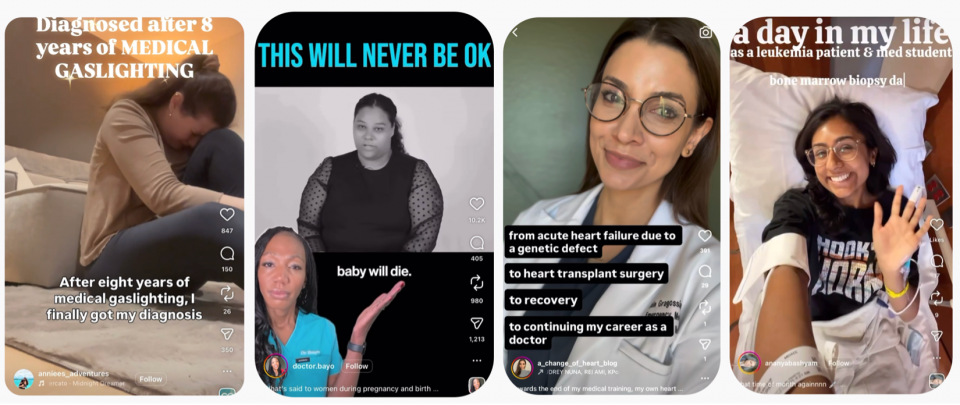
- Many individuals use social media to share personal healthcare experiences, including feeling misdiagnosed, dismissed, or harmed by the healthcare system
- Medical gaslighting: The invalidation of a patient’s genuine clinical concerns without appropriate evaluation, often due to physician ignorance, implicit bias, or medical paternalism [11]
- Social media offers healthcare providers unique visibility into patients’ daily lives, behaviors, and environments, which can inform more personalized care and earlier intervention
- This access can be leveraged to enhance empathy and strengthen patient advocacy
- Increasingly, healthcare professionals are also sharing their own experiences with chronic illness, helping to narrow the gap between providers and patients and fostering a more humanized model of care
Addressing social media–based concerns in the clinical setting
- Lead with empathy and validation: Patients often present during moments of fear and uncertainty. Many have had prior negative healthcare experiences, which can contribute to mistrust. Acknowledge their concerns and meet them where they are
- Explore context: Ask what specifically resonated with them in the content they viewed and what concerns them most. Focus the discussion on symptoms and clinical reasoning rather than anchoring on a self-diagnosis
- Share your mental model and set expectations: Clearly explain your clinical approach. Emphasize that the goal of the emergency department is not always to arrive at a definitive diagnosis, but to rule out life-threatening pathology, provide symptom management, initiate appropriate investigations, and arrange follow-up when needed
- Provide brief education: Offer guidance on how to identify credible medical information online and direct patients toward trusted resources
Reminder: The goal is not to win an argument, but to provide clarity, context, and reassurance
Final thoughts
Social media is a powerful tool that can support learning, professional development, and collaboration. The goal is not for every healthcare professional to become a content creator, but rather to recognize the value of engaging with these platforms in a thoughtful and intentional way.
Perhaps most importantly, social media offers a unique window into the lived experiences of our patients. By engaging with these perspectives, we can develop greater empathy and insight, ultimately strengthening how we communicate, advocate, and deliver care in the emergency department
References
- Digital 2026 Global Overview Report. We Are Social [Internet]. 15 Oct 2025 [cited 18 Feb 2026]. Available from: https://wearesocial.com/ca-en/blog/2025/10/digital-2026-global-overview-report/
- Common Sense Media. The Common Sense Census: Media Use by Tweens and Teens, 2021 [infographic]. San Francisco (CA): Common Sense Media; 2022. Available from: https://www.commonsensemedia.org/sites/default/files/research/report/2022-infographic-8-18-census-web-final-release_0.pdf
- Social media. In: Merriam-Webster.com Dictionary [Internet]. Merriam-Webster, Inc.; c2026. Available from: https://www.merriam-webster.com/dictionary/social%20media
- Alsaid B, Al-Bitar A, Mousa L, Al-Mardini H, Almaradni MM, Alhomsi H, et al. Short social media videos as a supplementary educational resource in neuroanatomy: a nonrandomized clinical trial. JAMA Netw Open. 2025 Sep 2;8(9):e2533971. doi:10.1001/jamanetworkopen.2025.33971.
- Hariri NH, Alruwais AT, Sodagar WM, Allhaiby NM, Moglan TM, Kinkar LI, et al. Association between social media use and patients’ choice of medical practitioners among the general population in Saudi Arabia: a cross-sectional study. Healthcare (Basel). 2025 Nov 11;13(22):2870. doi:10.3390/healthcare13222870.
- Southwell BG, Brennen JSB, Paquin R, Boudewyns V, Zeng J. Defining and measuring scientific misinformation. Ann Am Acad Pol Soc Sci. 2022;700(1):98–111. doi:10.1177/00027162221084709.
- George JF. Discovering why people believe disinformation about healthcare. PLoS One. 2024;19(3):e0300497. doi:10.1371/journal.pone.0300497.
- Canadian Medical Protective Association. 10 tips for using social media in professional practice [Internet]. Ottawa (ON): CMPA; 2024 Jan [cited 2026 Feb 25]. Available from: https://www.cmpa-acpm.ca/en/advice-publications/browse-articles/2024/10-tips-for-using-social-media-in-professional-practice
- Instagram Help Center — Explore content page (official Instagram support article). Instagram Help Center [Internet]. Meta Platforms, Inc.; c2026. How posts are chosen for Explore on Instagram. Available from: https://help.instagram.com/487224561296752
- Starcevic V, Berle D, Arnáez S. Recent insights into cyberchondria. Curr Psychiatry Rep. 2020 Aug 27;22(11):56. doi:10.1007/s11920‑020‑01179‑8. PMID:32852626; PMCID:PMC7450158.
- Ng IKS, Tham SZL, Singh GD, Thong C, Teo DB. Medical gaslighting: a new colloquialism. Am J Med. 2024:S0002-9343(24)00396-6. doi:10.1016/j.amjmed.2024.06.022
