
Disseminated intravascular coagulation (DIC) is an acquired, life-threatening disorder characterized by systemic activation of coagulation, dysregulated fibrinolysis, and, as emphasized in the updated definition, endothelial injury. It exists on a continuum, from subtle laboratory abnormalities and compensated coagulopathy to overt DIC with thrombosis, bleeding, and end-organ dysfunction. Yet DIC is often recognized only at the latter end of that spectrum.
This matters in the emergency department (ED). The ED is often where the underlying trigger first declares itself and where the earliest abnormalities in coagulation are identified. If earlier recognition of DIC can alter its trajectory, as the International Society on Thrombosis and Haemostasis (ISTH) now proposes, this is where much of that opportunity exists.
In 2025, the ISTH published a major update to its DIC definition and scoring framework, more than two decades after the original 2001 overt DIC score. This post reviews what changed, why it matters to emergency physicians, and how to apply the new framework on shift. It draws on the 2025 ISTH consensus statement alongside expert opinion from hematology and critical care consultants.
- Describe the 2025 ISTH framework for DIC
- Recognize the role of baseline coagulation labs and serial trending
- Apply the SIC and ISTH overt scoring tools in the right clinical context
- Discuss how early recognition shapes disposition, communication, and downstream therapy
Here, we will use sepsis as its primary model, since it is the trigger where the scoring framework is most developed. The principles apply across all etiologies.
Background: The Problem with DIC
DIC is common, carries substantial mortality, exists on a spectrum rather than as a binary diagnosis, and is frequently underrecognized. A 2025 meta-analysis of 119 studies found that approximately 28% of patients with sepsis met the 2001 ISTH criteria for overt DIC, while 55 to 57% met the more sensitive SIC or JAAM criteria for earlier sepsis-associated coagulopathy. Coagulopathy is similarly common in other high-risk conditions: approximately 25% of major trauma patients develop trauma-induced coagulopathy, while DIC prevalence reaches 47 to 58% in acute promyelocytic leukemia (APL) and over 50% in placental abruption [13].
Outcomes are poor and vary substantially by trigger. Reported mortality is approximately 42% in sepsis, 36% in trauma, 32% in heat stroke, 28% in hematologic malignancy, and 8% following snakebite. The presence of DIC is also strongly associated with mortality, with reported odds ratios of 3.15 in sepsis and 4.80 in trauma [13]. Despite major advances in critical care and trauma resuscitation, outcomes associated with DIC have changed relatively little over the past two decades.
One premise underlying the new ISTH framework is that part of the problem may be when we recognize DIC. If DIC is identified only once overt consumptive coagulopathy, bleeding, or organ dysfunction has developed, the opportunity to intervene earlier may already have been lost [19]. For many patients, that recognition begins, or fails to begin, in the emergency department.
DIC is missed for predictable reasons. Early laboratory abnormalities are subtle and nonspecific. Abnormal coagulation studies are often interpreted simply as “bleeding risk” rather than as a marker of an evolving systemic process. DIC is conceived of as a binary diagnosis rather than a continuum. And despite widespread awareness of scoring systems, they are rarely applied in practice: a 2026 ISTH survey spanning 27 countries found that only 28% of physicians routinely used a formal DIC score despite 76% reporting familiarity with the available tools [12].
“Early recognition of DIC for me is a marker of how sick a patient is, more than anything.”
— Dr. Hendin, Critical Care
The 2025 ISTH Update: Why Now
The way we diagnose DIC has evolved from identifying overt coagulopathy toward recognizing the process earlier in its course. The original 2001 ISTH overt DIC score was designed to identify established disease, using platelet count, PT prolongation, fibrinogen, and broadly defined elevations in fibrin-related markers. In 2017, the sepsis-induced coagulopathy (SIC) score introduced a tool specifically aimed at identifying an earlier phase of coagulation dysfunction in sepsis [2]. By 2019, a two-step approach had emerged: screen septic patients using SIC, then apply the ISTH overt DIC score as the disease progresses [2].
The 2025 ISTH update takes this evolution further, revising both the definition of DIC and the framework through which it is recognized [19]. The major conceptual change is that DIC is no longer framed simply as an overt coagulopathy that is either present or absent. Instead, it is understood as a dynamic process that evolves through phases and differs according to its underlying trigger.
Several changes matter clinically:
- Endothelial injury is now explicitly incorporated into the definition, alongside systemic coagulation activation and dysregulated fibrinolysis.
- A phase model is formalized, progressing from pre-DIC to early-phase DIC and ultimately overt DIC. This makes serial assessment central to diagnosis rather than relying on a single set of laboratory values.
- D-dimer thresholds are now explicit, with >3× and >7× the upper limit of normal replacing the less specific fibrin-related marker categories used in the 2001 score.
- DIC is recognized as etiology-dependent. Sepsis, trauma, APL, and obstetric catastrophes do not produce identical coagulopathies, and their phenotypes, laboratory evolution, and management priorities differ.
Importantly, the rationale for detecting DIC earlier remains consensus-based rather than RCT-proven. The central hypothesis is that recognizing the process before overt decompensation may allow earlier treatment of the underlying trigger, closer monitoring, and, in selected phenotypes, targeted intervention before irreversible organ injury occurs [19]. Demonstrating this is difficult because DIC is not a single disease: sepsis, trauma, APL, and obstetric catastrophe produce coagulopathy through overlapping but distinct mechanisms, making both patient selection and therapeutic trials challenging.
This distinction matters. The 2025 framework does not prove that calculating a score earlier improves mortality. Rather, it gives clinicians a framework for recognizing an evolving process earlier, at a point when intervention may still have greater potential to alter its course.
Roughly one in three septic patients meets criteria for overt DIC, yet many are never labelled as such. If the ISTH hypothesis holds, the emergency department is where much of the opportunity for earlier recognition, and whatever benefit ultimately comes from it, will occur.
“Timely intervention is often ineffective once initiated at the overt stage. Timely recognition should lead to timely intervention, which should lead to better outcomes.”
— Dr. Khalife, Hematology
Pathophysiology
The 2025 ISTH defines DIC as “an acquired, life-threatening intravascular disorder characterized by systemic coagulation activation, dysregulated fibrinolysis, and endothelial injury, resulting in microthrombosis.”
The key word is systemic. An underlying trigger produces widespread endothelial injury and activation, promoting tissue factor expression, thrombin generation, platelet activation, and fibrin deposition throughout the microvasculature. At the same time, endogenous anticoagulant pathways become impaired. The result is widespread formation of platelet-fibrin microthrombi, with consumption of platelets and coagulation factors along the way: the classic consumptive coagulopathy.
But coagulation is only half the story. Fibrinolysis is also dysregulated, and the direction of that dysregulation depends heavily on the underlying trigger. In some forms of DIC, fibrinolysis is suppressed, allowing fibrin-rich microthrombi to persist and promoting organ dysfunction. In others, fibrinolysis is markedly activated, accelerating fibrin and fibrinogen breakdown and producing a predominantly hemorrhagic phenotype. This interaction between coagulation, fibrinolysis, endothelial injury, and the underlying disease explains why DIC can present with thrombosis, bleeding, organ dysfunction, or some combination of all three.
Not All DIC Looks the Same
Thrombotic DIC, classically seen in sepsis, is characterized by coagulation activation with relative suppression of fibrinolysis. Microvascular thrombosis and organ dysfunction predominate, while clinically significant bleeding may occur later in the disease course.
Hemorrhagic DIC, seen particularly in APL and obstetric catastrophes and in some forms of severe trauma-associated coagulopathy, is characterized by marked fibrinolytic activation. Platelets and fibrinogen fall, coagulation parameters become increasingly abnormal, and bleeding becomes the dominant clinical problem.
These phenotypes are not mutually exclusive, and patients can evolve from one to another as the underlying disease progresses or is treated.
Just as importantly, DIC is a continuum rather than a binary diagnosis. The 2025 framework describes progression from pre-DIC, where coagulation abnormalities may be subtle, through an early phase, where the process is established but still compensated, to overt DIC, where consumption, thrombosis, bleeding, and organ dysfunction become clinically apparent.
In sepsis, the SIC score is intended to identify coagulation dysfunction earlier in this trajectory, while the ISTH overt DIC score identifies more advanced disease. This is why a single set of coagulation studies provides only a snapshot. The direction of travel matters.
Diagnosis: Triggers, Labs, and Scoring
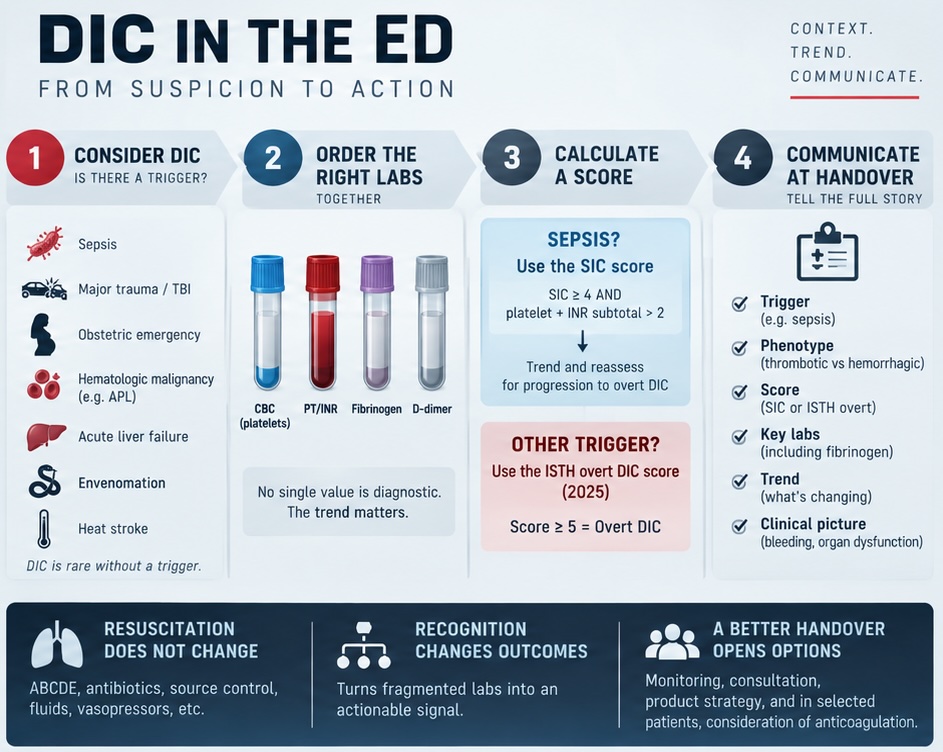
DIC does not occur in isolation. If an appropriate trigger is present, such as sepsis, major trauma or TBI, an obstetric catastrophe, hematologic malignancy (particularly APL), acute liver failure, heat stroke, or envenomation, DIC belongs on the differential. Conversely, apparent DIC without an obvious trigger should prompt a rapid search for the underlying cause.
Diagnosis begins with the clinical context, not the coagulation panel. No single laboratory value diagnoses DIC, and the same abnormality can mean very different things depending on the underlying disease and how it changes over time.
Four core laboratory tests should generally be ordered together:
- Platelet count: Thrombocytopenia, and particularly a falling platelet count, is often one of the earliest clues to evolving DIC. It is highly nonspecific, however, with a broad differential in critically ill ED patients. The trajectory is often more informative than the absolute value.
- PT/INR: Prolongation reflects consumption of coagulation factors and contributes to both the SIC and ISTH overt DIC scores. Like thrombocytopenia, it is nonspecific and must be interpreted in context, particularly in patients with liver disease or taking vitamin K antagonists.
- Fibrinogen: This one is easy to misinterpret. Fibrinogen is consumed in DIC, but it is also an acute-phase reactant. In sepsis, increased hepatic production can initially compensate for consumption, meaning the fibrinogen may be normal or even elevated despite active DIC. A normal fibrinogen therefore does not exclude DIC. By the time fibrinogen falls below 1 g/L, significant consumption is generally already present. This is one reason fibrinogen is not included in the SIC score.
- D-dimer: D-dimer reflects degradation of cross-linked fibrin and therefore provides evidence that both fibrin formation and fibrin breakdown have occurred. It is sensitive to coagulation activation but highly nonspecific, particularly in sepsis, trauma, malignancy, pregnancy, and critical illness. It also cannot, by itself, tell you whether the overall fibrinolytic phenotype is enhanced or suppressed. Assays and upper limits of normal vary between institutions, which is why the 2025 ISTH score expresses thresholds relative to the local ULN.
ISTH Overt DIC Score (2025)
A score of ≥5 is consistent with overt DIC [19].
|
Parameter |
Value |
Points |
|---|---|---|
|
Platelets |
50–100 / <50 ×10⁹/L |
1 / 2 |
|
D-dimer |
>3× / >7× ULN |
2 / 3 |
|
PT prolongation |
3–<6 / ≥6 seconds |
1 / 2 |
|
Fibrinogen |
<1 g/L |
1 |
The major 2025 change here is the D-dimer component. The original ISTH score used qualitative categories of fibrin-related marker elevation; the updated score provides explicit thresholds of >3× and >7× the upper limit of normal [19].
Sepsis-Induced Coagulopathy (SIC) Score
In patients with sepsis, SIC is designed to identify coagulation dysfunction earlier than the ISTH overt DIC score [2].
|
Parameter |
Value |
Points |
|---|---|---|
|
Platelets |
100–150 / <100 ×10⁹/L |
1 / 2 |
|
INR |
>1.2–1.4 / >1.4 |
1 / 2 |
|
4-component SOFA¹ |
1 / ≥2 |
1 / 2 |
SIC is present with a total score ≥4 AND a combined platelet + INR score >2.
¹Only the respiratory, cardiovascular, hepatic, and renal components of SOFA are included.
SIC should not be thought of as synonymous with DIC. Rather, it identifies sepsis-associated coagulation dysfunction at an earlier point in the trajectory. Among patients who ultimately progress to overt DIC, SIC frequently appears first; one study found it preceded overt DIC in 93.9% of cases that progressed [18].
Applying the Scores in the ED
For sepsis, think SIC first, overt DIC second. A positive SIC score should prompt recognition of evolving sepsis-associated coagulopathy, serial laboratory assessment, and reassessment for progression toward overt DIC. For other triggers, the ISTH overt DIC score provides a practical general framework, although disease-specific criteria exist and the score should always be interpreted in the context of the underlying etiology.
Neither score replaces clinical judgment, and neither score is itself an indication for transfusion.
A bleeding patient with evolving coagulopathy may require treatment despite an ISTH score below 5. Conversely, a hemodynamically stable, non-bleeding patient who meets laboratory criteria for overt DIC does not automatically require blood products. The score identifies the syndrome; the phenotype and clinical context determine what you do about it.
Most importantly, DIC is dynamic. A platelet count of 110 that was 250 six hours ago means something very different from a stable platelet count of 110 for three days. The same is true of INR, fibrinogen, and D-dimer. If DIC is suspected but the initial picture is equivocal, repeat the coagulation panel during the patient’s ED course whenever feasible. In SIC-positive sepsis or a patient with evolving abnormalities, an earlier repeat is reasonable.
Practically, aim for at least one repeat set of coagulation studies before the patient leaves the ED when evolving DIC is a meaningful concern. The individual values matter, but the direction of travel matters more.
Management
Management of DIC rests on three principles: treat the underlying cause, support hemostasis when clinically necessary, and identify patients in whom thrombosis rather than bleeding is the dominant phenotype. The score identifies the syndrome, but it does not tell you what product to give.
1. Treat the Underlying Cause
This is the most important intervention. DIC is a manifestation of another disease, and no amount of factor or platelet replacement will control ongoing coagulation activation if the underlying trigger persists.
In sepsis, this means antibiotics, source control, and appropriate hemodynamic resuscitation. In trauma or obstetric catastrophe, it means hemorrhage control and definitive management. In suspected APL, it means early hematology involvement and urgent disease-specific therapy.
Importantly, a diagnosis of DIC does not fundamentally change the initial resuscitation of the critically ill patient.
2. Treat Bleeding, Not the Coagulation Panel
Abnormal coagulation studies alone are generally not an indication for transfusion. Blood products are primarily used when DIC is accompanied by active bleeding, hemorrhagic shock, or the need for an invasive procedure with significant bleeding risk.
|
Product |
Consider when |
|---|---|
|
Cryoprecipitate / fibrinogen concentrate |
Active bleeding with significant hypofibrinogenemia, generally <1.5 g/L |
|
FFP |
Active bleeding with prolonged PT/aPTT and suspected coagulation-factor depletion |
|
Platelets |
Active bleeding or high-risk procedure with significant thrombocytopenia; commonly target >50 ×10⁹/L in major bleeding |
|
Massive transfusion protocol |
Hemorrhagic shock requiring massive transfusion |
Severe thrombocytopenia without bleeding is a separate consideration. At very low platelet counts, generally around <10 ×10⁹/L, prophylactic platelet transfusion may be appropriate even in the absence of active bleeding, although this reflects general platelet-transfusion practice rather than a DIC-specific threshold.
Obstetric DIC also deserves special consideration. Fibrinogen falls rapidly in major obstetric hemorrhage, and a fibrinogen <2 g/L is concerning for severe hemorrhage and should prompt early replacement according to local obstetric massive hemorrhage protocols, rather than waiting for the <1 to 1.5 g/L thresholds used in other forms of DIC.
A patient with early or predominantly thrombotic DIC may therefore require no blood products at all. The purpose of replacement is to treat clinically important hemostatic failure, not to normalize the INR, platelet count, or fibrinogen.
3. What About Anticoagulation?
This is where DIC becomes more complicated.
The pathophysiologic argument is compelling: if the dominant problem is systemic thrombin generation and microvascular thrombosis, anticoagulation might interrupt the process before progressive organ injury occurs. The 2025 ISTH framework therefore identifies anticoagulant therapy as a potential treatment for thrombotic DIC, while replacement therapy predominates in the hemorrhagic, decompensated phenotype [19].
The clinical evidence, however, is considerably less certain.
A 2016 meta-analysis included 24 randomized trials and 14,767 patients with sepsis. Anticoagulant therapy did not reduce mortality in unselected sepsis or in the broader sepsis-induced coagulopathy population. In the subgroup with established sepsis-induced DIC, however, anticoagulant therapy was associated with lower mortality (RR 0.72, 95% CI 0.62–0.85), although bleeding complications tended to increase [9]. Importantly, these studies evaluated several different anticoagulant strategies, and the DIC subgroup represented only a subset of the overall trial population. (PubMed)
This is therefore not evidence for routine anticoagulation of SIC or early DIC in the ED. Anticoagulation may be considered when thrombosis clearly predominates, particularly with overt thromboembolism, purpura fulminans, or another compelling thrombotic indication, but the decision should generally be made with hematology or critical care.
For the emergency physician, the important step is recognizing and communicating the phenotype:
“Sepsis with SIC, falling platelets, rising INR, preserved fibrinogen, no active bleeding: concern for evolving thrombotic DIC.”
That handover is more useful than simply reporting “platelets 80.”
“A patient in early phase DIC may not require any products. The focus is on anticoagulation, to prevent microthrombosis and tissue damage.”
— Dr. Khalife, Hematology
The latter remains an area of evolving evidence and should not be interpreted as a recommendation for routine ED anticoagulation.
What This Changes in the ED
The framework does not change the first 60 minutes of resuscitation. It changes four things:
- Your resuscitation stays the same. ABCDE, antibiotics, source control, hemorrhage control, fluids and vasopressors where appropriate. Treat the underlying disease first.
- Your label changes. Instead of “sepsis with low platelets,” recognize “sepsis with SIC, concern for evolving DIC.” In other contexts, identify overt DIC and its likely phenotype rather than treating each coagulation abnormality in isolation.
- Your labs become a trajectory rather than a snapshot. Calculate and document the score explicitly: SIC ≥4 with a platelet + INR subtotal >2 in sepsis, or ISTH overt DIC ≥5. More importantly, repeat the coagulation studies when feasible and pay attention to the direction of travel.
- Your handover changes. Communicate the trigger, phenotype, score, fibrinogen, and trend. “SIC positive, platelets falling, INR rising, fibrinogen preserved, no active bleeding” conveys considerably more than “platelets 80.”
The value of the label and score is not the label itself. They convert a collection of nonspecific laboratory abnormalities into recognition of an evolving systemic process. That recognition can influence monitoring, disposition, timing of repeat investigations, consultant involvement, blood-product strategy, and, in selected patients, consideration of phenotype-directed therapy.
In other words, you may not change what you do in the first hour, but you may change what happens over the next six.
Limitations
There are important limitations to this framework.
- Consensus, not trial-proven. The central hypothesis, that earlier recognition and intervention will improve patient-important outcomes, has not been demonstrated in randomized trials. A better diagnostic framework does not necessarily mean better outcomes.
- DIC is heterogeneous. Sepsis, trauma, APL, obstetric catastrophe, and other triggers produce overlapping but mechanistically distinct coagulopathies. This complicates clinical trials and means evidence from one DIC phenotype cannot necessarily be generalized to another.
- The scores simplify a dynamic process. SIC and ISTH overt DIC reduce complex biology to a small number of laboratory and clinical variables. They support clinical judgment; they do not replace it.
- Assays and thresholds vary. D-dimer assays and upper limits of normal differ between institutions, while many transfusion thresholds remain based largely on observational data and expert consensus rather than randomized trials.
- Serial testing is easier to recommend than to perform. Repeating coagulation studies several hours later may be difficult during a short or crowded ED stay. The ideal frequency of reassessment is also not firmly established and should depend on the patient’s clinical trajectory.
- Treatment evidence remains limited. In particular, evidence supporting anticoagulation for thrombotic DIC remains uncertain, and pregnancy-specific management requires integration with obstetric hemorrhage protocols rather than simple application of the general DIC framework.
Conclusion
“The ED [is] a uniquely important setting, arguably the most important, for detecting sepsis-associated coagulopathy at a moment when it is still evolving and potentially reversible.”
— Iba et al., 2026 [16]
DIC is common, carries substantial and largely unchanged mortality, and is frequently underrecognized at the stage when intervention could matter most. The 2025 ISTH framework asks for three low-cost additions to standard care: order targeted coagulation labs early and trend them, apply the SIC score in sepsis and the ISTH overt DIC score when appropriate, and carry phenotype, score, and trajectory explicitly into the handover.
Your resuscitation does not change. Your recognition, your trending, and your handover do.
References
- Kiya GT, Abebe G, Mekonnen Z, et al. A comparison of DIC scoring systems and their performance to predict mortality in sepsis patients: systematic review and meta-analysis. PLoS ONE. 2025;20(1):e0315797.
- Iba T, Levy J, Raj A, Warkentin T. Advance in the Management of Sepsis-Induced Coagulopathy and DIC. J Clin Med. 2019;8(5):728.
- Morikawa M, Nii M, Nakabayashi Y, et al. Capacity of Japanese institutions to manage obstetrical DIC in 2018. J Obstet Gynaecol Res. 2021;47(9):3159–70.
- Hayakawa M, Seki Y, Ikezoe T, et al. CPG for DIC in Japan 2024: part 4, trauma, burn, obstetrics, liver failure. Int J Hematol. 2025;121(5):633–52.
- Asakura H. CPG for DIC in Japan 2024: significance of disease-specific guidelines. Int J Hematol. 2025;121(5):586–91.
- Yamakawa K, Okamoto K, Seki Y, et al. CPG for DIC in Japan 2024. Part 1: sepsis. Int J Hematol. 2025;121(5):592–604.
- Kawano N, Ikezoe T, Seki Y, et al. CPG for DIC in Japan 2024. Part 2: hematologic malignancy. Int J Hematol. 2025;121(5):605–21.
- Seki Y, Okamoto K, Ikezoe T, et al. CPG for DIC in Japan 2024. Part 3: solid cancers, vascular abnormalities. Int J Hematol. 2025;121(5):622–32.
- Iba T, Levi M, Thachil J, et al. ISTH SSC communication on sepsis-induced coagulopathy in the management of sepsis. J Thromb Haemost. 2023;21(1):145–53.
- Erez O, Othman M, Rabinovich A, et al. DIC in Pregnancy: Pathophysiology, Clinical Characteristics, Diagnostic Scores, and Treatments. J Blood Med. 2022;13:21–44.
- Gando S, Levi M, Toh CH. Disseminated intravascular coagulation. J Intensive Care. 2025;13(1):32.
- Nwagha TU, Hajjaj OI, Levy JH, et al. Global practice and challenges in the diagnosis and management of DIC: ISTH SSC communication. J Thromb Haemost. 2026;24(5):1896–905.
- Umemura Y, Scarlatescu E, Nwagha TU, et al. Mortality, diagnosis, and etiology of DIC, a systematic review and meta-analysis: ISTH SSC communication. J Thromb Haemost. 2025;23(8):2663–79.
- Beechar VB, De La Flor C, Medford RJ. Non-typeable Haemophilus influenzae and purpura fulminans. BMJ Case Rep. 2020;13(7):e234880.
- Shinkai A, Ito T, Hashiguchi E, et al. Potential utility of the new ISTH overt DIC scoring system for mortality risk assessment: nation-wide database study in Japan. J Thromb Haemost. 2026;24(2):608–17.
- Iba T, Tanigawa T, Wada H, et al. Recognizing Coagulation Disorders in Sepsis in the Emergency Room: A Narrative Review. J Clin Med. 2026;15(2):488.
- Williams B, Zou L, Pittet JF, Chao W. Sepsis-Induced Coagulopathy: A Comprehensive Narrative Review. Anesth Analg. 2024;138(4):696–711.
- Yang H, Ma X, Li X. The diagnosis of DIC: a current overview. Front Med. 2025;12:1502628.
- Iba T, Levy JH, Maier CL, et al. Updated definition and scoring of DIC in 2025: ISTH SSC communication. J Thromb Haemost. 2025;23(7):2356–62.
