
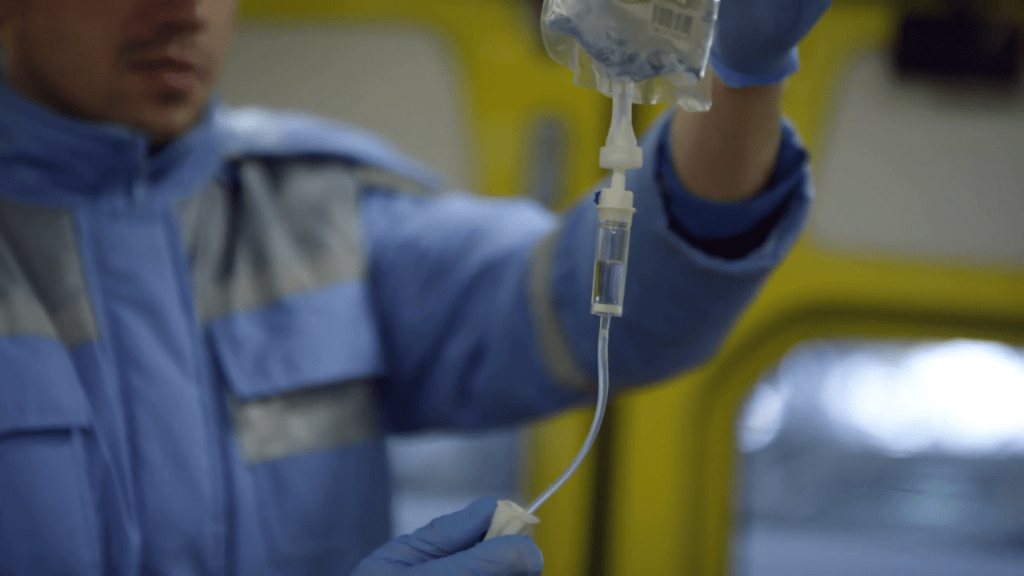
At this month’s Journal Club, we explored the use of IV vs IO access established during out-of-hospital cardiac arrests (OHCAs). In particular we took a deep dive into two trials:
IVIO trial versus PARAMEDIC-3 trial
Background
Establishing vascular access during out-of-hospital cardiac arrest (OHCA) is a core component of advanced life support. Intravenous (IV) access has traditionally been the first-line route, while intraosseous (IO) access offers a rapid alternative when IV attempts are challenging or delayed.
In 2024, two major randomized controlled trials (IVIO (Denmark) and PARAMEDIC-3 (UK)) were published in the New England Journal of Medicine. Both trials directly compared IV-first versus IO-first strategies in OHCA to determine whether IO access could improve return of spontaneous circulation (ROSC) or survival outcomes compared with IV.
Primary Outcome:
- IVIO Trial: Sustained return of spontaneous circulation
- PARAMEDIC-3 Trial: Survival at 30 days
Clinical Question
In adult patients with OHCA, does an IO-first strategy for vascular access improve ROSC, survival, or neurologic outcomes compared with an IV-first strategy?
Methods
Study Designs
Both studies were multi-centre, open-label randomized controlled trials conducted in real-world EMS systems. These studies were performed in Denmark and the UK for the IVIO and PARAMEDIC-3 trials, respectively. Patients in the IVIO trial were further randomized into humeral and tibial IO subgroups.
| Included Patients | Excluded Patients |
|
|
The IVIO trial had 1,479 patients included with a mean age of 70 years whereas the PARAMEDIC-3 trial consisted of 6,082 patients with a mean age of 68 years.
EMS System & Training Differences
- IVIO (Denmark):
- Conducted within a Danish EMS system that included physicians as part of the prehospital team.
- All clinicians completed an online training module, and additional practical IO training was provided if they were not already proficient.
- PARAMEDIC-3 (UK):
- Conducted in paramedic-based EMS systems in the UK, without physicians routinely present in the field.
- No additional pre-study IO training was required; paramedics were considered competent in both IV and IO based on existing practice.
This difference in pre-study training and team composition is an important contextual factor when interpreting procedural performance and external validity.
Main Results
IVIO Trial
The first-attempt success for the IO group was 85% compared 61% in the IV group with a comparable mean time to epinephrine of 15 minutes between the groups. There was no difference in sustained ROSC between the IO (30%) and IV (29%) group. Similarly, there was no difference observed between the tibial or humeral IO groups.
Humeral vs Tibial IO (IVIO Sub-analysis)
A sub analysis was performed in the IVIO trial where patients who obtained IOs underwent imaging to assess catheter position. Overall, 71% of the humeral IO catheters had correct placement whereas tibial catheters were correctly positioned in 100% of cases. This suggests that tibial IO may offer more reliable placement than humeral IO in practice, at least in this system.
PARAMEDIC-3 Trial
The first-attempt success was significantly higher in the IO group (95%) compared to the IV group (65%). Despite IO having clearly higher first-attempt success in both trials, this did not translate into shorter time to drug administration. Further, there was no significant difference in 30 day survival between IO and IV groups (4.5% and 5.1%, respectively). Both ROSC and sustained ROSC to hospital handover were slightly higher in the IV group, with an approximately 2% absolute difference, but not enough to change practice alone.
Overall, neither trial demonstrated a clear survival or neurologic advantage for IO over IV.
Limitations
Both studies were open-label designs which has the potential to introduce bias. Furthermore, procedural metrics and outcomes that were measured could have been easily influenced by operator skill and variable placement location. These studies were also limited by the lack of post ROSC / hospital care data which essentially limits the assessment of neurologic outcome. In particular the IVIO trial was underpowered to detect differences in survival or neurologic outcomes and was not specifically designed around patient centered outcomes. The PARAMEDIC-3 trial, of note, was stopped early for detection of a 1% mortality difference rendering the data more limited.
Bottom Line
In summary, IO access did not outperform IV in achievement of ROSC, survival or final neurologic outcomes. The totality of evidence suggests that access route (IV vs IO) is less important than minimizing time to effective drug delivery, within the context of high-quality CPR and well-organized resuscitation systems. Generally, IV should remain first-line, with IO as a critical backup when IV is delayed or difficult.
The key operational priority should be:
“Whichever route you choose, get access fast and deliver epinephrine early.”
Full Citation
IVIO Trial:
Vallentin MF, Granfeldt A, Klitgaard TL, Mikkelsen S, Folke F, Christensen HC, et al. Intraosseous or intravenous vascular access for out-of-hospital cardiac arrest. N Engl J Med. 2025;392:349–60. doi: 10.1056/NEJMoa2407616.
PARAMEDIC-3 Trial:
Couper K, Ji C, Deakin CD, Fothergill RT, Nolan JP, Long JB, et al; PARAMEDIC-3 Collaborators. A randomized trial of drug route in out-of-hospital cardiac arrest. N Engl J Med. 2025;392:336–48. doi: 10.1056/NEJMoa2407780.