Every December, the Emergency Department changes character a little.
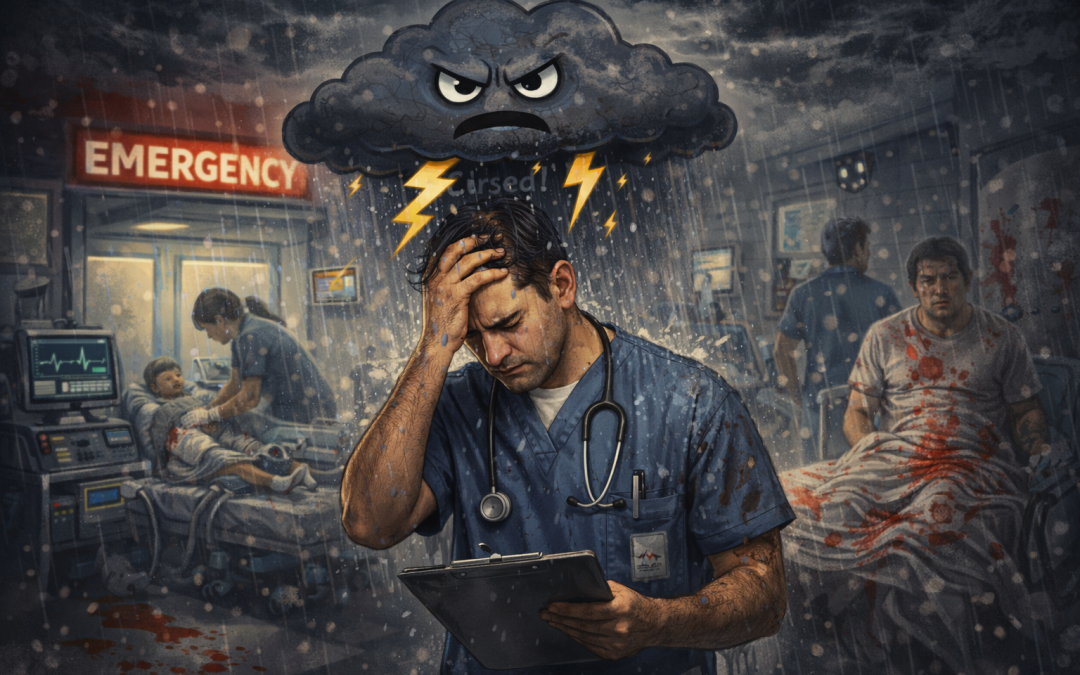
Lights show up around the nursing station. Someone brings in shortbread that appears to pre-date the Roman Empire. There is Christmas music. Someone inevitably wrongly claims that “Die Hard” is not a Christmas movie, and then somewhere during a shift, we hear it: “I’m a dark cloud, tonight is going to be busy”, or “don’t worry, my white cloud will balance you out”.
We usually say it jokingly, with a grin, but also with a hint that perhaps there is something real beneath the joke. The idea that some clinicians attract chaos while others quietly float through serene shifts is deeply embedded in our culture. It is also, almost certainly, wrong and, I would argue, can be cognitively harmful.
So yes, my Christmas post this year is me stepping outside, packing a snowball, and tossing it straight at our obsession with “clouds.”
People Have Actually Studied This, and It Is… Underwhelming
For what it is worth, people have actually studied this. This isn’t just folklore passed around on night shifts. Over 35 months, researchers in apheresis medicine tracked emergent events to see if particular clinicians carried more “bad luck” than others. They didn’t. The distribution mirrored what probability predicts, not what superstition imagines. No cursed physicians emerged from the data.¹
A separate analysis of admissions among family physicians initially appeared to reveal high-volume and low-volume “types,” but once reasonable statistical adjustments were applied, those apparent “clouds” evaporated.²
Residency literature offers similar lessons. Residents who self-identify as “black clouds” genuinely feel busier and more stressed. But when researchers match that perception to actual case logs? No meaningful differences. What they do tend to see is:
- Greater recall of dramatic events
- More rumination
- Sometimes higher burnout scores… which makes intuitive sense.
Result: randomness wins, and perceiving chaos begets chaos
Across the literature, the theme repeats. When we measure it, “clouds” don’t behave like real phenomena. They behave like human narrative layered onto stochastic systems.
If Santa reviewed these studies, he’d probably shrug and say: “You’re not cursed. It’s variance.”
Why the Story Feels True (Especially Around the Holidays)
Medicine runs on probability, but humans really dislike probability. Three resuscitations back-to-back does not feel random. It feels targeted. It feels meaningful. It feels like the universe circled your name in red pen. So, we tell a story; “Dark cloud, White cloud, Lucky shift, Unlucky shift, Cursed week”.
The brain prefers narrative to math, and we are predictably bad at recognizing random patterns.
A few biases do much of the work:
Clustering illusion: When Randomness Looks Intentional
One of the reasons “clouds” feel convincing is that randomness does not behave the way we expect. In our minds, probability should distribute itself evenly. A little quiet, a little busy, back and forth in a fair balance. But that is not how complex systems work. Random events arrive in clumps. You can go an hour with almost nothing, then suddenly have three critically ill patients at once. It feels targeted, personal, almost narrative. In reality, those streaks are exactly what randomness produces. We misinterpret normal statistical clustering as evidence that something (or someone) is causing it.
Availability bias: We Remember the Loud Moments
The next layer is availability bias. Our memories privilege what is emotionally charged, dramatic, and unusual. Very few of us can recall the middle hours of a boring shift with any detail. But we remember the toddler seizure, the unexpected airway, the crashing GI bleed. These moments become anchor points. When we later reflect on our careers, or even on a specific month of shifts, it is those moments that appear first in our minds. The long stretches of normalcy vanish, leaving us with a distorted sense of frequency: “It always happens when I’m on.” No, those are simply the episodes our memory refuses to let go of.
Confirmation bias:Once We Believe It, We Keep Proving It
Once the “cloud” narrative takes hold, confirmation bias does the rest. If someone calls you a dark cloud, or if you call yourself one, your brain starts collecting evidence. Busy shift? See, proof. Sick patients? Proof again. Meanwhile, quieter shifts are brushed aside as exceptions. The bias is subtle. We are not actively lying to ourselves. Rather, our attention becomes selective. We notice the data points that fit the story and ignore the ones that do not. Over time, the pattern feels undeniable, even though it has largely been curated by our expectations.
Regression to the mean: Bad Runs Eventually Settle
Finally, regression to the mean plays a huge role. In any high-variance environment, there will be extreme stretches, both unusually bad and unusually quiet. But those extremes almost always drift back toward average performance over time. A punishing run eventually eases. A golden stretch eventually normalizes. We almost never interpret that as statistics doing what statistics do. Instead, we say things like, “My luck finally turned,” or “I must be on a better streak now.” The clouds change names, and the story survives.
Putting it Together
Individually, each of these biases is understandable. Together, they create an illusion where randomness feels personal, luck feels like identity, and performance feels tied to something almost mystical. That would be merely amusing if it stayed at the level of joking. But it rarely does.
Calling someone a “dark cloud” may feel like harmless gallows humour, yet repeated over time, it shapes self-concept. A resident begins to believe bad shifts follow them. Outcomes feel personal. The work feels somehow “about” them rather than about timing, case mix, system strain, and the inevitable volatility inherent in emergency care. That mindset invites rumination, helplessness, and self-blame, exactly the psychological states we should be trying to buffer our learners from. On the other side, “white clouds” may unconsciously attribute calm shifts to personal competence or aura rather than to chance, reinforcing equally unhelpful illusions.
Meanwhile, the narrative distracts us from the factors that truly deserve attention: staffing ratios, boarding pressures, patient flow, time-of-day effects, seasonal surges, and system inefficiencies. Those are real. Those are tractable. Clouds are not.
So yes, my Christmas post this year is essentially a friendly snowball fight with the idea of clouds: partly playful, partly earnest, and aimed at loosening our grip on a story that feels true but probably isn’t. Some shifts are hard. Some stretches are brutal. None of that means the universe has singled you out.
As one of my favourite staff in residency used to say; ‘there’s no such thing as a shit magnet, just people talking too much’.
Clouds make sense on radar screens and in crayon drawings. They don’t belong in our narratives about competence, identity, or fate, and if you still think the universe is picking on you?
That’s not Christmas magic.
That’s statistics, and they don’t care who’s on shift.
References
-
Haspel RL, et al. The myth of the “black cloud”: workload in apheresis medicine. Transfusion. 2018.
-
Ely JW, et al. Does the “black cloud” phenomenon exist? Variation in inpatient admissions among family physicians. Fam Med. 2018.
-
Meier A, et al. “Black cloud” residents: perceptions vs. objective workload. J Grad Med Educ. 2013.
-
Park YS, et al. Resident workload, perception of “cloud,” and burnout. Teach Learn Med. 2019.