
With a new year, comes a new BHP Corner. For those who are new to this part of our EM Ottawa Blog, it is here that we cover up and coming topics of discussion within our Regional Paramedicine Program for Eastern Ontario (RPPEO). Written by the base-hospital physicians, these commentaries focus in on trends in paramedicine care with tangible real-life take-homes.
To view our earlier blog posts click HERE.
This month, Dr. Michael Austin, Medical Director for the RPPEO highlights the importance of Feedback, the essential pulse of progress.
Scenario.
To begin, let’s start with a case.
Paramedics Alex (Primary Care Paramedic) and Brenda (Advanced Care Paramedic) are responding to a call for an elderly lady with altered level of consciousness at an assisted living facility. Upon arrival, they find a 68-year-old lady on the ground with snoring respirations.
Initial Assessment and Treatment:
Alex performs a primary survey upon arrival. He opens the airway and ensures that the patient has a pulse. Brenda performs vital signs and a blood glucose measurement. The patient is found to be hypotensive and her oxygen saturations are low. While Alex takes a history from the facility staff, Brenda applies oxygen, starts an IV and initiates a fluid bolus. The fire department arrives and assists with lifting the patient to a stretcher to facilitate extrication. The patient’s vital signs and mentation improve as they are transported to hospital.
Post-Call Debrief:
We find Alex and Brenda now in the ambulance bay where they are having a chat as they get to cleaning up post call. Flip through the pictures below to see the interaction.
Analysis.
This example, taken from the pages of a medical procedural, illustrates how feedback can highlight ares for improvement that might not be immediately obvious in the heat of the moment. By focusing on communications, Alex enhances his ability to provide comprehensive care and uphold a professional demeanour at a time of crisis. The informal feedback from his partner fosters a culture of continuous learning and improvement.
Alex appreciates that Brenda has the confidence and comfort to suggest ways to improve the care they provide as a team. Brenda is grateful for Alex’s approachability and willingness to listen and grow, which allows her to speak up when she sees an opportunity to enhance patient care. Together, they can discuss and address these insights as a team. This collaborative approach leads to better patient outcomes, a more empathetic, and effective paramedic team, and helps prevent unaddressed concerns that could otherwise. lead to workplace conflict and professional consequences.
The Power of Feedback in Healthcare.
Feedback, though sometimes uncomfortable, is essential for continuous improvement and delivering the highest standard of care for every patient we serve. In many organizations, feedback is deeply embedded in education, training, and daily professional activities. It serves as a valuable tool to indicate whether things are on the right track or if adjustments are needed. In healthcare, feedback provides practitioners with insights into their practice through the eyes of their peers, helping to consolidate strengths and identify ares for improvement, ultimately improving patient care.
“Feedback fosters a culture of continuous learning and improvement, ultimately leading to better patient outcomes”
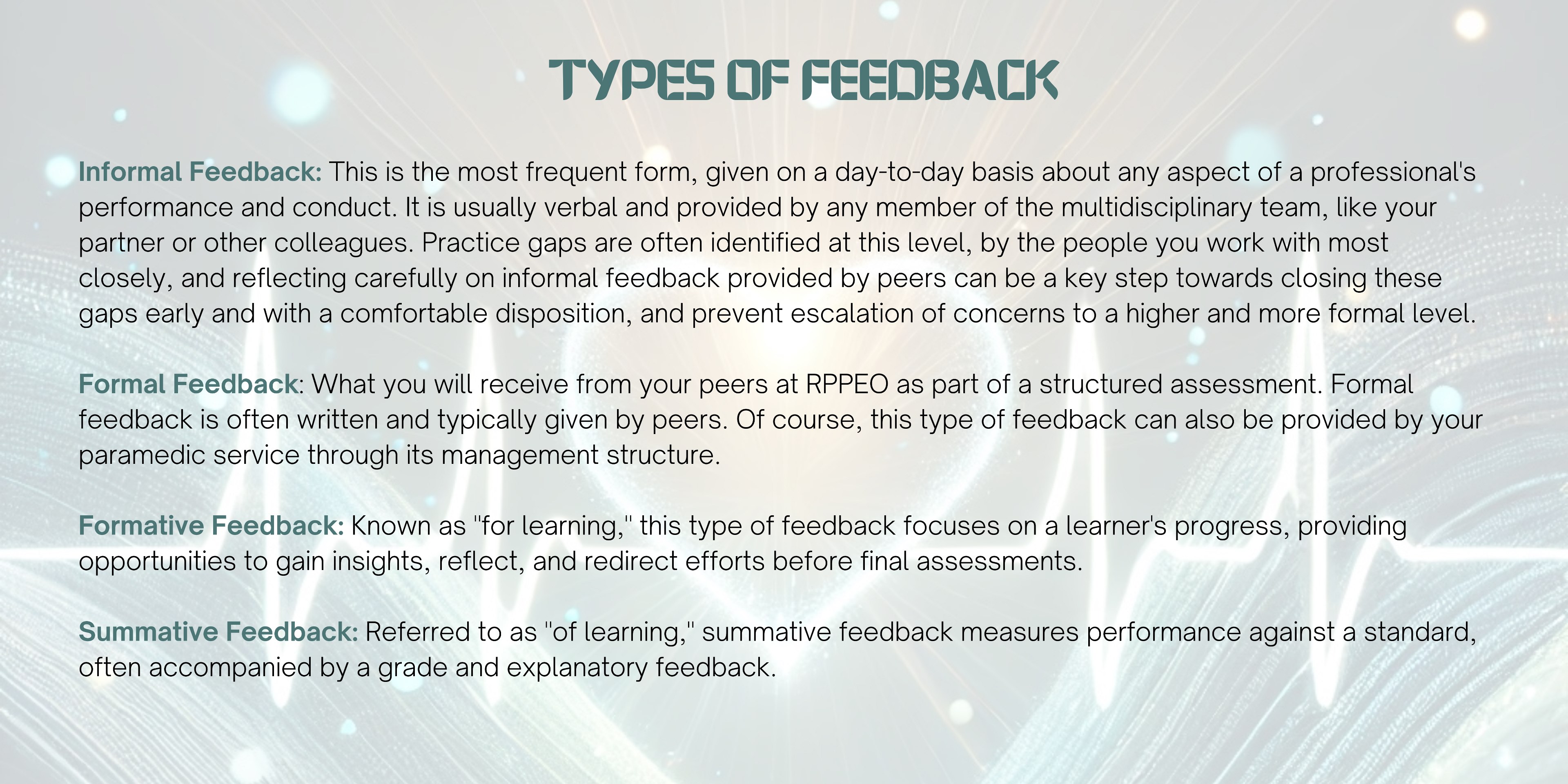
Formal feedback from your peers at the RPPEO is designed to support you in delivering safe patient care, enhancing your performance, and fostering professional growth. It enables paramedics at all levels to gain valuable insights into their practice, allowing them to refine their skills and improve patient outcomes. Whether feedback comes from peers, superiors, or patients, it helps build a more reflective and competent healthcare workforce. Remember, your peers may often ask targeted questions to ensure the feedback is specific and actionable. Stay open-minded, as this process aims to make you a better clinician and support optimal and safe patient care.
Why Feedback Matters.
Appropriate feedback significantly contributes to developing competence and confidence at all stages of a healthcare professional’s career. It helps bridge the gap between actual and desired performance, promoting reflective and experiential learning. More importantly, feedback aids in constructively addressing underperformance, fostering an environment where continuous improvement is the norm.
Paramedics are in a unique situation within healthcare, as they work side by side with a partner who can provide immediate and constructive feedback. This dynamic allows paramedics to support each other directly in the field, a feature that is rare in other healthcare settings and should be optimized.
“… paramedics support each other directly in the field, a feature that’s rare in other healthcare settings”
Without feedback, professionals may assume their current practices are adequate, leading to a false assessment of their skills and abilities. Performance gaps that go unaddressed can also lead to workplace conflict and professional consequences. This can result in stagnation and potentially compromised patient care. Conversely, constructive feedback helps identify and address gaps in knowledge and practice, driving better patient outcomes and more comfortable workplace relationships with peers and superiors.
Making the Most of Feedback.
To maximize the benefits of feedback, it is crucial to approach it with an open mind and a willingness to learn. Here are some tips for RECEIVING feedback effectively:
– Listen Actively: Pay attention to the feedback without interrupting. Show that you value the insights being offered.
– Ask Clarifying Questions: If something is unclear or you don’t understand, ask for specific examples or further explanation.
– Reflect on the Feedback: Take time to consider the feedback and how it can be applied to improve your practice. Some of you might find writing this down a good exercise. It is natural to feel criticized and defensive when receiving feedback, even when it’s provided in a safe and supportive manner. Recognize this feeling and understand that it is a natural one. If a response is required, it’s often helpful to take time (at least 24 hours) to consider and reflect on the feedback before responding. Speaking with trusted peers about the feedback can also be helpful for reflection.
– Take Action: Implement changes based on the feedback and monitor the results. Continuous improvement is an ongoing process, and the hallmark of professional practice. In fact, it is the willingness and maturity to examine critically how we are performing, and make changes to our practice based on self-reflection, evidence, and feedback from others, that will continue to drive paramedics towards professional independence.
When you embrace feedback as a tool for learning and not a weapon of judgment, you create space for connection, trust and professional growth. Take a breath. Explore those moments of discomfort – they’re where the real growth happens.
When delivering feedback, it is important to cultivate a culture where feedback is viewed as constructive professional development. If you by chance are the one providing feedback, here are some tips to remember:
– Be Specific: Focus on specific behaviours rather than general comments. This helps the received understand exactly what needs to be improved.
– Be Timely: Provide feedback as soon as possible after you see a behaviour. This way it’s relevant and fresh in the receiver’s mind.
– Be Balanced: Highlight strength as well as areas for improvement. Balanced feedback is more constructive and less likely to be perceived as criticism.
– Encourage Self-Reflection: Encourage the receiver to reflect on their performance and identify areas they believe need improvement. Feedback may begin with a question to explore the rationale and causality for an action or behaviour, and to prompt an individual to reflect on how things went and how they could be done better for next time. Learning is often deeper and more meaningful if the individual self-identifies an area that needs improvement.
– Be Respectful: Feedback is received more constructively in a safe, respectful environment, in which the individual is respected as a valuable professional. It is okay to be tough on the subject, but be soft on the person.