
Question: To identify the prevalence of non-shockable ECG rhythm but ventricular fibrillation (VF) by Echo in out-of-hospital cardiac arrest (OHCA). To determine the clinical relevance of occult VF and whether it affects survival to hospital discharge, ROSC, and termination of VF.
Methods: 811 adult patients were enrolled from multiple centres across US and Canada from 2021-2024. Patients were included if they had atraumatic OHCA with resuscitation ongoing, and had 1 simultaneous recording of ECG and Echo image during the initial 3 pauses of CPR. Experts were blinded and reviewed the images at a later date. Echo VF was predefined as visible myocardial fibrillatory activity. Patients were followed to death or discharge.
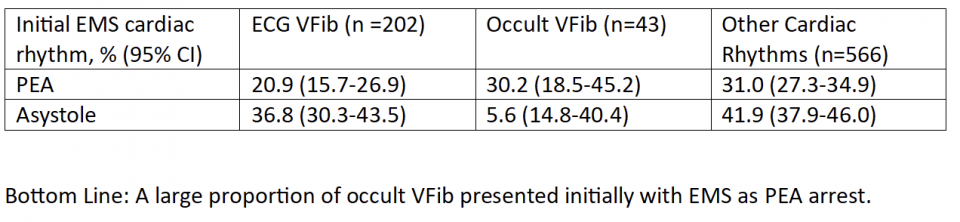
Findings: 5.3% of all OHCA were found to have occult VF on bedside Echo during the initial 3 pauses of CPR. Most of the Occult VF rhythms were ECG PEA (81%) vs. ECG asystole (19%). The survival to discharge for ECG VF and Occult VF were similar despite less defibrillation attempts for Occult VF (54% vs. 30%).
Limitations: Limited generalizability of results due all ECG and Echo images being reviewed by expert Echo reviewers which may not be available in most situations. Most centres included were mostly academic with access to TTE and TEE, although removing the TEE studies did not change outcomes. Interrater reliability for ECG and Echo images was substantial for agreement between reviewers. No statistical significance in any of the secondary outcomes.
Interpretation: Bedside Echo can assist in detecting occult VF in OHCA. This may have the potential to improve survival for patients who would have otherwise been managed as PEA/asystole. Consider using bedside Echo rapidly to identify the need for defibrillation even if the ECG rhythm is PEA/asystole.