
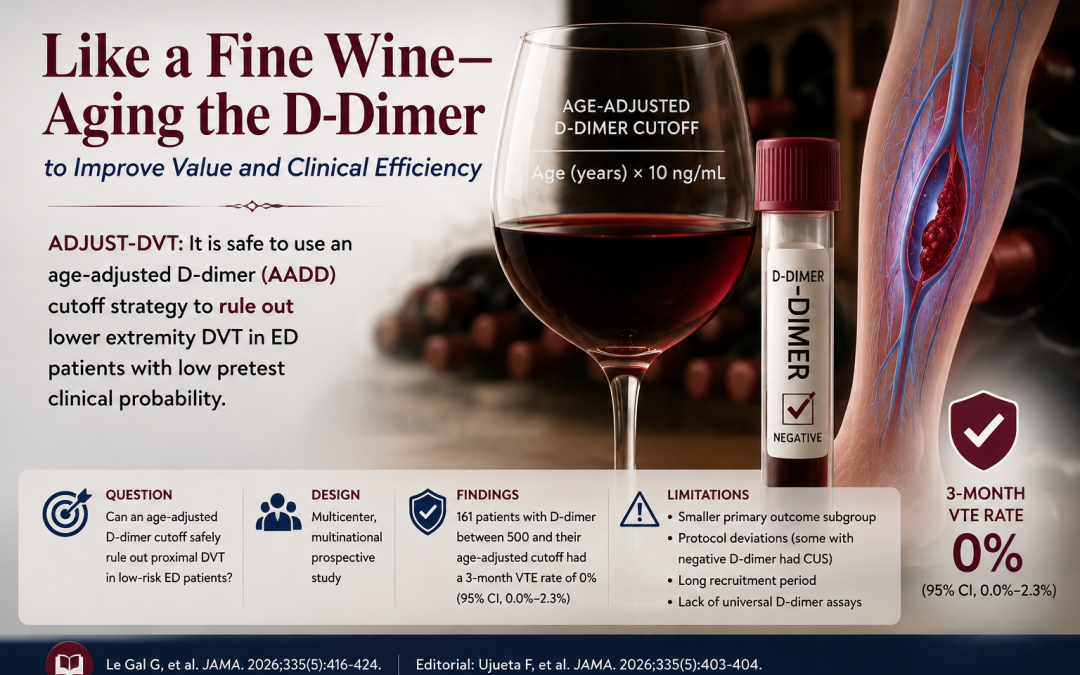
Age-Adjusted D-Dimer Cutoff Levels to Rule Out Deep Vein Thrombosis.
Le Gal G, et al. JAMA. 2026 Feb 3;335(5):416-424. doi: 10.1001/jama.2025.21561.
Editorial: Like a Fine Wine—Aging the D-Dimer to Improve Value and Clinical Efficiency.
Ujueta F, et al. JAMA. 2026;335(5):403–404. doi:10.1001/jama.2025.23182
Methodology: 4/5
Usefulness: 5/5
Question and Methods: ADJUST-DVT evaluated the safety of using an age-adjusted D-dimer (AADD) cutoff for ruling out lower extremity proximal DVT in a multicenter, multinational prospective study.
Findings: 161 patients had a high sensitivity d-dimer result between 500 and their age-adjusted cut-off with a 3-month VTE rate of 0% (95% CI, 0.0%–2.3%).
Limitations: Smaller primary outcome subgroup, protocol deviations with some patients with negative d-dimer undergoing CUS, long recruitment period, and lack of universal d-dimer assays.
Interpretation: It is safe to use an AADD cut-off strategy to rule out lower extremity DVT in ED patients presenting with a low pretest clinical probability.