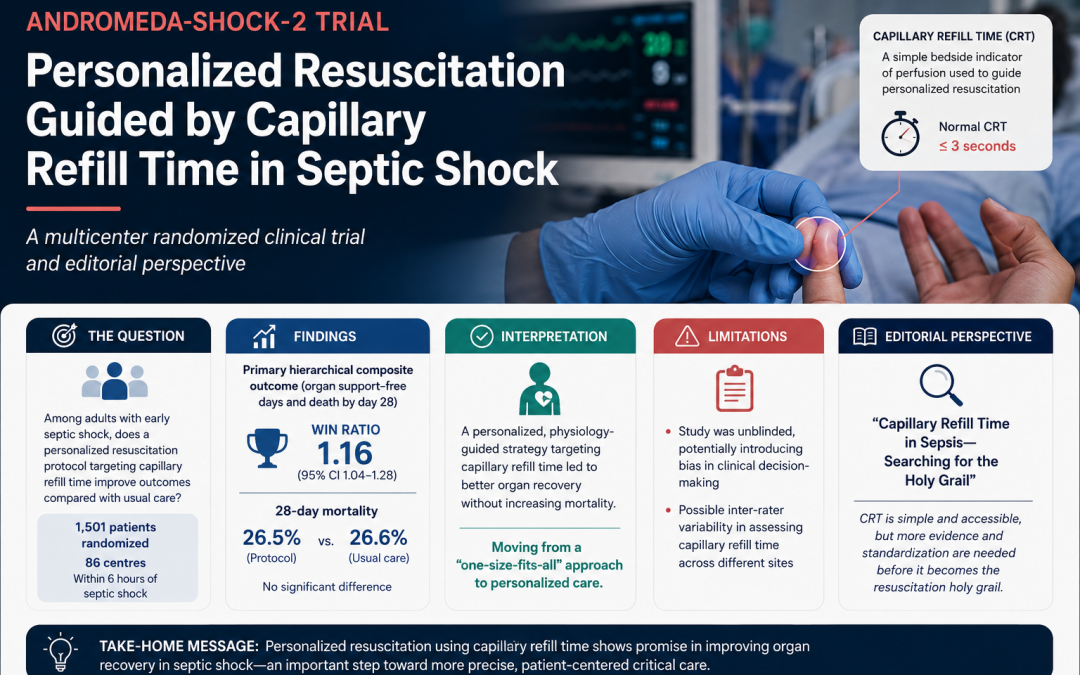
Personalized Hemodynamic Resuscitation Targeting Capillary Refill Time in Early Septic Shock: The ANDROMEDA-SHOCK-2 Randomized Clinical Trial.
Editorial:
Capillary Refill Time in Sepsis-Searching for the Holy Grail.
Machado FR, et al. JAMA. 2025 Oct 29. doi: 10.1001/jama.2025.20518.
Methodology: 4.5/5
Usefulness: 4/5
Question and Methods: 1501 patients were randomized across 86 centres to a personalized resuscitation protocol vs. standard of care within 6 hours of septic shock to improves outcomes
Findings: The protocol was superior to usual care for the primary hierarchical composite outcome (Win ratio 1.16, 95% CI 1.04-1.28), though 28-day mortality was similar (26.5% vs. 26.6%).
Limitations: The study was unblinded, potentially introducing bias in clinical decision-making, and possible inter-rater variability in assessing capillary refill time across different sites
Interpretation: This suggests moving from a “one-size-fits-all” resuscitation to a personalized, physiology-guided approach to accelerate organ recovery.